Contacts move. Addresses do not.

An ISP sells to addresses, and most CRMs only know people. We build HubSpot around the passing, connect it to billing and serviceability, and tie every campaign to the subscribers it signed.

Connected to the broadband industry.

A Calix Select Partner, with ties to the associations that serve fiber and rural broadband providers.

Where ISPs usually start

Marketing spend nobody can tie to take rate. A billing system doing the CRM's job. A HubSpot portal that needs a workaround for everything, because it was built for contacts and you sell to addresses. Start with whichever one is yours.

  1. Spend to take rate

    Campaigns measured by counting inbound calls

    Direct mail, digital, door-to-door, and the only way to know what worked is the phone ringing. We build reporting at the address level, so a campaign is judged by the take rate in the neighborhoods it reached, and the number that goes to the CFO is one you can check.

    • Address-level campaign attribution
    • Take rate by area, campaign, and channel
    • Pre-build demand campaigns
    Talk through attribution
  2. One record per address

    The billing system is doing the CRM's job

    Billing knows everything about a customer and can do almost nothing with it. Sales notes live in a spreadsheet, leads arrive in an inbox, and nobody can pull up a household and see what marketing activities have occurred. We build HubSpot around the passing, keep it in step with billing, and route every lead to a rep while it is still warm.

    • Custom passings object and serviceability data
    • Billing and OSS/BSS sync
    • Lead routing by territory and serviceability
    Talk through your data model
  3. Built for how you sell

    HubSpot takes more work than it gives back

    The portal was set up for contacts, and you sell to addresses, so every campaign starts with a manual upload and a workaround. The team uses it to send the newsletter and not much more, when it could be running abandoned cart follow-up, pre-build campaigns, and lead routing on its own. We rebuild it around the address, train each role on its own workflow, and document it inside the portal.

    • Portal audit and remediation
    • Address-based rebuild
    • Training by role and in-portal documentation
    Talk through your portal

Each system keeps its own job.

The website sells. HubSpot coordinates. Billing and the network say what is live. The same person can be a prospect at one address and a subscriber at another, so we settle which system owns each fact before anything is connected.

  1. Sell

    Website and buy flow

    Check an address, see the right offer, place the order, book the install, without a phone call. An abandoned checkout comes back with an address attached and a way to follow up.

    • Serviceable address to the right offer
    • Order and appointment handoff into HubSpot
  2. Coordinate

    HubSpot

    Person, household, address, marketing permissions, and every campaign touch in one record that marketing, sales, and service all work from. Lifecycle stages that mean something to an ISP: future footprint, serviceable, ordered, installed, active.

    • Passings object and ISP lifecycle stages
    • Campaign, pipeline, and service reporting
  3. Operate

    Billing, serviceability, and operations

    The systems that know whether an address is serviceable, built, or billed keep owning those facts. They send the signals to HubSpot. HubSpot does not overwrite them.

    • Serviceability, build status, and territory from the source system
    • Billing, service, and churn signals back into reporting and automation

Relevant proof

What ISPs say afterward.

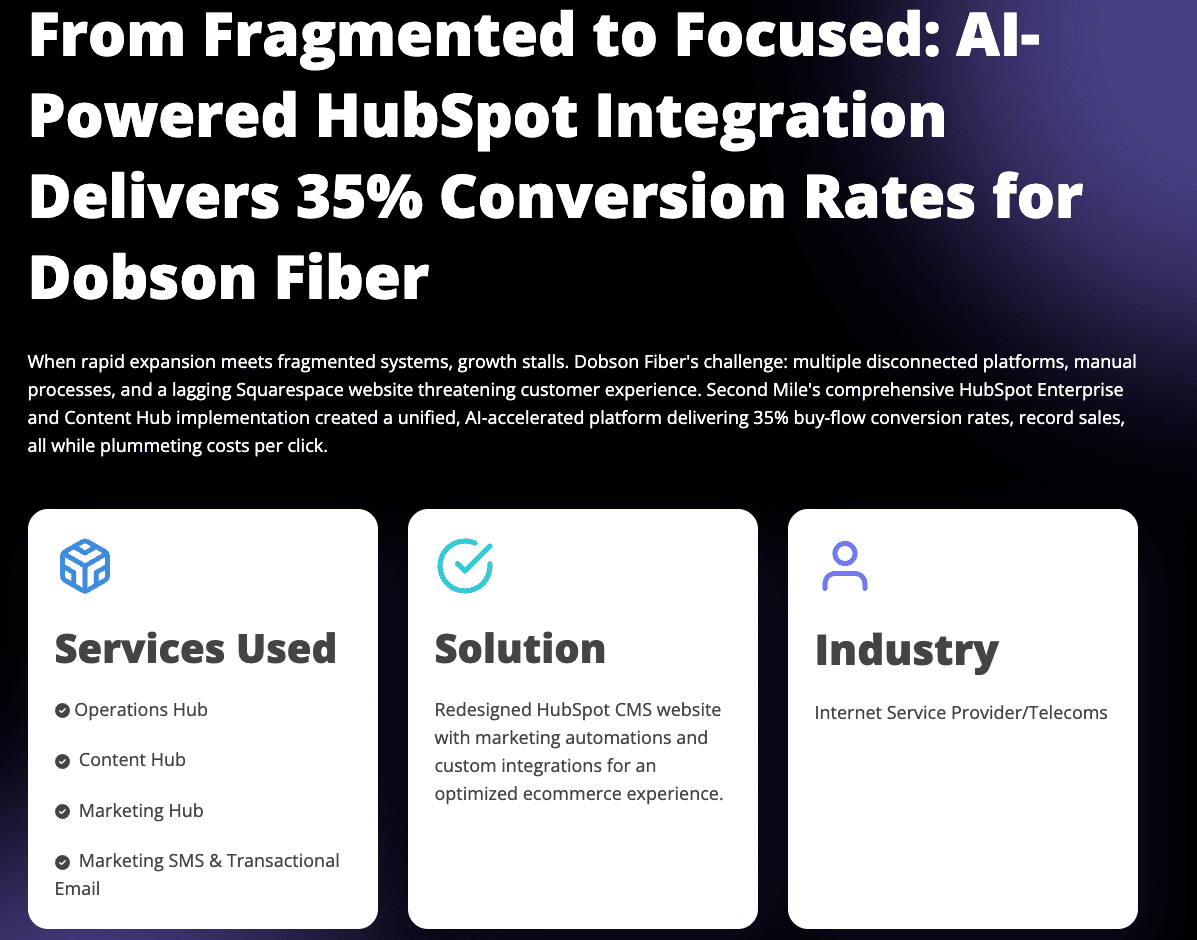
“I appreciate all that you’ve done for the Dobson Fiber team. Yesterday was a record ecommerce sales day here thanks to our workflows, HubSpot, and your work.”
Jeremy D.Dobson Fiber
Proof storyDobson FiberAddress data, HubSpot, and ecommerce working as one system. The decisions behind a record order day, and what the team runs on its own now.Read the work
35%
Ecommerce conversion rate · Dobson Fiber
89%
Higher one-day order record · Dobson Fiber

How an ISP engagement starts

HubSpot does not replace the OSS or BSS. Discovery settles which system owns availability, billing, and subscriber status, and how an exception reaches someone who can act on it. Discovery is part of the engagement.
  1. Map

    Name the handoff that breaks

    Where a lead, an order, or an address falls between systems today, who owns the data on each side, and what it costs the customer when it fails. We decide which system owns each fact before deciding what moves.
  2. Build

    Test with real addresses and real orders

    The first phase is built so it can be tested against your own addresses and orders, including the handoffs between the website, HubSpot, and the billing or serviceability platform, before anyone in the field depends on it.
  3. Adopt

    Put it in the team's hands

    The people who will run the process are trained on their own part of it, and the documentation lives inside the portal where they work. By handover, the team knows the system well enough to run it with confidence, and it is theirs.

Choose the next useful step

Find your next move.

We will help identify the operating question, the systems involved, and the smallest first phase that can make the architecture more dependable.

Talk through the problem

Connect with our team

Talk through your challenges and see if Second Mile is the right partner to help.

Discuss your architecture

Find the right service

Explore our services

See the evidence

Explore our work

Common questions

What makes HubSpot different for an ISP?

The customer is an address before it is a person. Serviceability, household, order status, and subscriber status all decide what marketing, sales, and service should do next, and a standard contact record holds none of it. We add a passings object for address-level data, ISP lifecycle stages, and the connections to billing and serviceability that keep them true.

Does HubSpot replace our billing system or OSS/BSS?

No. Billing, provisioning, and network systems keep owning availability, build status, and subscriber status. HubSpot receives those facts, uses them for marketing, sales, and service, and sends its own signals back. Deciding which system owns each fact is the first thing settled in discovery.

We already bought HubSpot and the team barely uses it. Where do we start?

With an audit of the portal you have. Most stalled ISP portals were set up around contacts and never matched how the company sells, so the team went back to spreadsheets. The audit shows what to keep, what to rebuild around the address, and what training each role needs, and it becomes the roadmap for the rest.

Can you connect our billing, serviceability, and provisioning platforms?

Usually, yes. We have connected HubSpot to NISC, Calix, Sonar, CrowdFiber, and VETRO, among others. Where a platform has no usable API we say so early and design around it, and where the data disagrees between systems we agree the rules for which one wins before anything is built.

Can we start with one service area?

Yes, and many engagements do. One market's pre-build campaign, one buy flow, or one lead-routing workflow is a good first phase because it can be tested against real addresses and orders. The scope stays where you put it. When clients expand later, it is because the map showed them something worth doing next.

How do you tie marketing spend to take rate?

Every campaign touch is recorded against the address as well as the contact, and serviceability and order status come from the source systems. That makes it possible to report take rate by campaign, channel, and area, and to show what a direct mail drop or a door-to-door push produced in the neighborhoods it reached.

Who monitors the integrations after launch?

That is agreed in handover. If you have in-house technical staff, we document the monitoring and hand it to them. If you do not, we strongly recommend a small maintenance and support engagement, because billing and serviceability platforms change on their own schedules and someone has to be watching.