





Built for companies that outgrew the spreadsheet years ago.

Marketing in one tool, sales in another, the customer list in a spreadsheet, and nobody able to say which campaign produced the deal. We connect the website, HubSpot, and the systems behind them, so marketing, sales, service, and finance work from the same facts and leadership gets a report it can trust.

B2B companies we've worked with.

Selected clients across our HubSpot, website, and integration work.

  • D&Y
  • Arrowhead Winch
  • LEO Events
  • ALTO
  • WD Partners
  • LYT
  • Synaptics

Where mid-market B2B teams usually start

Event leads sitting in a spreadsheet a month after the show. An email platform that has never met the CRM. A leadership meeting that opens with an argument about whose number is right. Start with whichever one is yours.

  1. Marketing that can see the pipeline

    An email tool that has never met the CRM

    Marketing sends from one platform and sales works in another, so nobody knows whether a prospect opened the email before the call, badge scans from the conference sit in a spreadsheet until they go cold, and the question of which campaign produced the deal has no answer. We bring marketing into HubSpot beside the sales record, so every open, click, form fill, and event visit lands on the contact, follow-up starts on its own, and every deal carries its source.

    • Email marketing and nurture inside HubSpot
    • Event and campaign follow-up automation
    • Source and campaign attribution
    Talk through your marketing
  2. One record per customer

    A website inquiry, a sales opportunity, and a customer as three records

    The form fill lands in one place, the deal lives in another, and once the contract is signed the customer becomes a row in the accounting system that marketing and sales never see again. Enterprise accounts with ten contacts across three regions get one contact record and a lot of lost context. We map which system owns each fact, connect the website and HubSpot to the systems behind them, and give marketing, sales, service, and finance one record to work from.

    • Website, HubSpot, and ERP or accounting connected
    • Multi-contact account structure
    • Lifecycle from inquiry to renewal
    Talk through your systems
  3. Reporting leadership trusts

    Contracts, invoices, and the leadership report built by hand

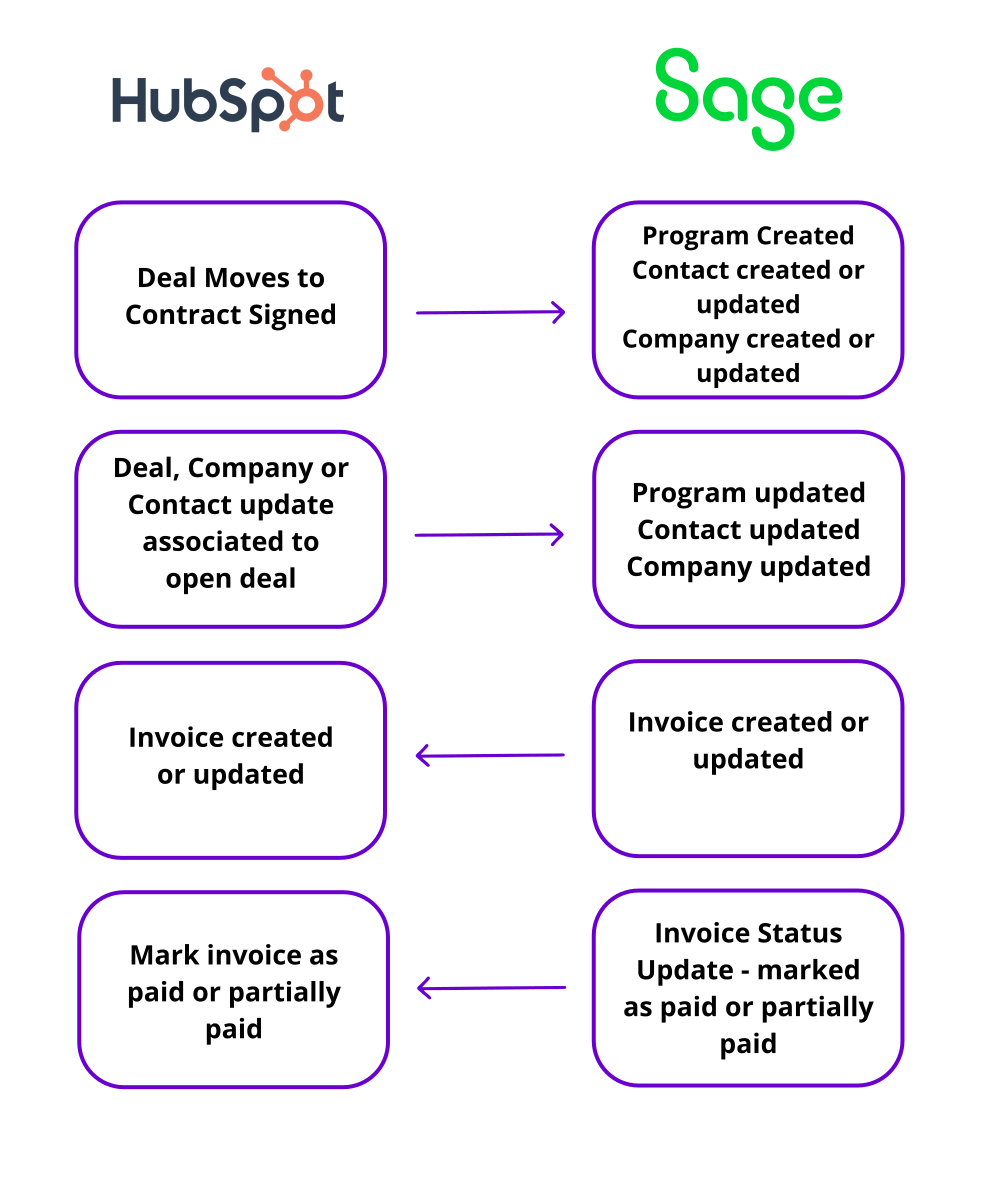
    A rep asks for an invoice in a spreadsheet, finance keys the deal into the accounting system, and the pipeline number in the leadership meeting depends on who built the slide. We build quotes inside HubSpot, connect it to the accounting system so invoices and their status come back to the deal on their own, and build dashboards from one source so pipeline, revenue, and margin are the same in every room.

    • HubSpot Quotes and contracts
    • Accounting and ERP integration (NetSuite, Sage Intacct)
    • Executive dashboards with revenue and gross profit
    Talk through reporting

Each system keeps its own job.

The website and the campaigns bring people in. HubSpot holds the relationship, the marketing history, and the pipeline. The accounting system or ERP owns the invoice and the revenue. We settle which one owns each fact before anything is connected, so nobody enters the same thing twice.

  1. Attract

    Website and campaigns

    Built on HubSpot CMS or WordPress so an inquiry, a download, or an event registration becomes a HubSpot record the moment it arrives, with the campaign and source recorded, and routed to the right rep while it is still warm.

    • Forms, chat, landing pages, and event lists into HubSpot
    • Source and campaign recorded on every contact
  2. Coordinate

    HubSpot

    Contact, company, deal, quote, and every email open, click, page visit, and call in one record for marketing, sales, and service. Nurture sequences, lead scoring, and pipelines built for how you sell, whether that is new business, pilots, renewals, or projects.

    • Marketing automation and lead scoring
    • Deal, pilot, and renewal pipelines
    • Dashboards for the leadership meeting
  3. Record

    ERP and accounting

    NetSuite, Sage Intacct, or the system you already run keeps owning the invoice, the payment, and the revenue. HubSpot sends the closed deal across and gets the invoice and its status back. Before anything is connected, we work out with you, field by field, which system has the final say.

    • Deal to invoice, invoice status back to the deal
    • Shared identifiers across sales and finance
    • Revenue and margin in the dashboards

Relevant proof

What mid-market teams say afterward.

The nurture sequences changed how we follow up after events. We used to scan badges and hope someone sent a follow-up email. Now leads go into a sequence automatically and we can see exactly who engaged before we reach out. It's a completely different experience.
Connie, Head of MarketingALTO US
Proof storyALTO US.Pipedrive, Mailchimp, and a spreadsheet of hundreds of store locations brought into HubSpot as one system, with event leads in a nurture sequence within a day and every deal carrying its source.Read the work
67%
Post-launch win rate · ALTO US
60 to 91%
Email open rates across the nurture sequence · ALTO US
241 hours
Manual work removed each year · LEO Events

The system, shown in the work.

A retail safety company's event-driven pipeline and an events agency's quote-to-cash put different demands on HubSpot. See the work in action.

Recent mid-market work also includes D&Y Staffing and Arrowhead Winch.

How the work starts

How an engagement starts

HubSpot does not replace the accounting system or the ERP. Discovery settles which system owns the customer, the contract, the invoice, and the revenue number, and what marketing, sales, and finance should each see when they open a record. Discovery is part of the engagement.
  1. Map

    Name the handoff that breaks

    Where a customer falls between systems today: the event lead nobody followed up, the email marketing sent to a list sales has never seen, the contract re-keyed into accounting, the report two departments dispute. We decide which system owns each fact before deciding what moves.
  2. Build

    Test with real contacts, real deals, and real invoices

    The first phase is built so it can be tested against your own contacts, campaigns, deals, and invoices, including the sync between HubSpot and the accounting system, before a marketer, a rep, or a controller depends on it.
  3. Adopt

    Put it in the team's hands

    Marketing, sales, service, and finance are each trained on their own part of the system, and the documentation lives inside the portal where they work. By handover, the team knows the system well enough to run it with confidence, and it is theirs.

Choose the next useful step

Find your next move.

Talk through the problem

Connect with our team

Talk through your challenges and see if Second Mile is the right partner to help.

Schedule a conversation

Find the right service

Explore our services

See the evidence

Explore our work

Common questions

Can you show us which campaigns are producing deals?

Yes. Every contact carries its source and every deal carries the campaign that started it, because marketing and sales live in the same system. Dashboards show pipeline and revenue by channel, campaign, and event, so the question of what to keep funding has an answer.

Does HubSpot replace our accounting system or ERP?

No. NetSuite, Sage Intacct, or whatever you run keeps owning the invoice, the payment, and the revenue. HubSpot holds the relationship, the marketing history, and the pipeline, sends the closed deal across, and receives the invoice and its status back. Which system owns each fact is settled in discovery.

We already have a CRM. Why add HubSpot?

Sometimes you should not, and we will say so. Where it makes sense, it is because HubSpot runs marketing, sales, and service from one record: email and nurture sequences, lead scoring, event follow-up, pipelines, and reporting on which campaigns produce revenue, with the accounting system connected behind it. Most general CRMs hold the pipeline and leave the go-to-market work to other tools. It is an expansion of what the stack can do, not a verdict on the last decision.

Can you connect HubSpot to NetSuite or Sage Intacct?

Yes. We map which fields move, in which direction, and what happens when the two systems disagree, and we test the sync against real deals and invoices before anyone depends on it. Where a native connector does the job we use it; where it does not, we build the connection.

Do we need a new website to do this?

No. Many engagements connect the existing site to HubSpot and stop there. Where the site is the problem, we build on HubSpot CMS or WordPress, and the two can be separate engagements or one.

Who monitors the integrations after launch?

That is agreed in handover. If you have in-house technical staff, we document the monitoring and hand it to them. If you do not, we strongly recommend a small maintenance and support engagement, because accounting platforms and ERPs change on their own schedules and someone has to be watching.