- Format
- Case study
- Topics
- HubSpot · Integrations · Residential sales
From Spreadsheets to Source of Truth: How Twin Valley Converts 43% of Abandoned Carts Into Orders
For more than 80 years, Twin Valley has connected rural Kansas to what's possible. As a fourth-generation, family-owned broadband and communications company, Twin Valley has built its legacy on a simple belief: small communities deserve world-class technology without sacrificing hometown service. But delivering cutting-edge connectivity is only part of the equation. Behind the scenes, the systems powering residential sales hadn't kept pace with the company's growth and ambition.
- Written by
- Natalie Eadie
- Client
- Twin Valley, Clay Center, Kansas
- Industry
- Internet service provider: fiber, Gig+ and mobile
- Published
Until 2025, Twin Valley's residential sales operations relied on disconnected exports, spreadsheets, paper slips, and a billing system that had never been integrated with HubSpot. The result was limited visibility into sales performance, no reliable way to measure the value of a door knock, and a median 36-hour delay before a sales representative could follow up on an abandoned online order.
Solution: A residential HubSpot build on Sales Hub Enterprise, Marketing Hub Professional, Data Hub Professional and Content Hub Starter: a custom Premise object, a residential lifecycle and pipeline, a daily one-way eLation API integration through a custom AWS service, a 15-minute CrowdFiber cart sync, a Spotio integration, custom-coded de-duplication, a 15-email nurture program with SMS, and the training and playbook behind them.
43%
of abandoned carts become orders, measured deal by deal on every cart at least 45 days old
2.6x
the 90-day order rate for door-knocked households against unknocked households in the same towns, 6.6% against 2.5%
73%
faster median time from an abandoned cart to a rep's first call or text, 36 hours down to under 10
The Challenge
By early 2025, Twin Valley was expanding its fiber network into seven Kansas growth markets, 15 when including Air Fiber, all while relying on just three field marketing representatives, a customer service team handling phone orders, and a presence at nearly 100 community events annually. The business sales team already lived in HubSpot, with dashboards, deals and activities. None of the residential work touched it. Online orders sat in CrowdFiber, phone orders went straight into the eLation billing system and door knocks were tracked by hand. Event leads were handwritten on paper slips, typed into a spreadsheet and followed up on once. A Zapier connection into HubSpot had lapsed.
The February 2025 audit put numbers on the gap. Marketing Hub Professional was licensed with no email, ads, forms or landing pages running and no tracking code on the site. The portal held one list, four workflows, four sequences nobody had been enrolled in, and custom properties left behind by four disconnected integrations. eLation, Spotio and HubSpot each held part of the picture of the same addresses. None of them agreed, and none could say which households in a growth market had been knocked, had started an order, or had been installed.
"We didn’t have visibility into the reps’ activities, what results they were getting or if they were spending their time in the right places," Josh Peterson, Sales Manager, said of the residential reps. "Somebody asked me, ‘What's the success rate on door knocking?’ I just didn’t have a way other than them manually tracking it, which had its problems, obviously, because it was in the spreadsheet."
Twin Valley's vision was clear: create a single, centralized hub that brings all residential customer data, sales activity, and insights together in one place.
The Strategy
Four decisions shaped the build.
Premise first, not contact first. A fiber provider sells to an address, and most passings have no name or email. So the HubSpot record is built around the premise, and field sales, marketing and customer service all work from the same list of passings.
Billing decides who is a customer. HubSpot reads the customer status from eLation rather than inferring it from deal activity, and residential customers get a lifecycle of their own, so their counts never mix with the commercial book the business team already ran.
One way, daily, over the eLation API. Orders, installs and disconnects change daily, so HubSpot pulls them once a day and never writes back. Abandoned carts change by the minute, so CrowdFiber syncs every 15 minutes.
Integrations write state, workflows route work. We recommended against rebuilding the lapsed Zapier connection and against chains of workflows that assemble customer status from deal events. Custom code writes the state. Workflows decide who does what next.
The build runs on Sales Hub Enterprise for the Premises custom object, the pipeline and sequences, Marketing Hub Professional for the nurture program and forms, and Data Hub Professional for the custom-coded actions and the custom integration service, which runs on AWS and calls the eLation API. Data Hub was the one addition to the hubs Twin Valley already ran. Go-live followed the data: eLation orders in September 2025, the CrowdFiber buyflow in October, Spotio in November, with the nurture program built alongside.
Change management aimed at a team that runs the system itself: recorded training sessions, office hours, and a written Integration Logic Playbook that sets out what each system sends, when, and what to check first when a record looks wrong. Twin Valley's marketing operations lead now owns the lifecycle rules and built the workflow that keeps commercial deals out of the residential lifecycle.
The Solution
The data model
-
A Premises custom object on Sales Hub Enterprise, one record per address, that contacts, deals and door-knock tasks attach to
-
A residential lifecycle: Prospect, Lead, Pending Order, Active Customer (Residential) and Inactive / Churned. Only the eLation integration sets Active Customer (Residential), once service is installed
-
A single Residential Pipeline in Sales Hub with one deal per order, marked Sold when the sale is made and attached to the premise and the contact it belongs to
-
Contact and company de-duplication running as custom-coded Data Hub workflow actions in Node.js, matching on address, phone, postal code and email variants, never on name alone
The integrations
-
eLation: a custom integration service on AWS calls the eLation API, takes the records changed since the last run, and writes contacts and order deals through the HubSpot CRM API, matched to premise and contact on the eLation account number and service address. eLation's statuses set the lifecycle stage, identifiers are never overwritten once set, and contacts without a name or email are held back
-
CrowdFiber: a scheduled job reads the buyflow and creates or updates an Abandoned Cart deal keyed on the CrowdFiber lead ID, so a returning shopper never creates a duplicate, with bot and spam submissions suppressed
-
Spotio: each door knock is written as a task on the premise through the Spotio pin ID on the record, and a workflow passes it to the household's contact.
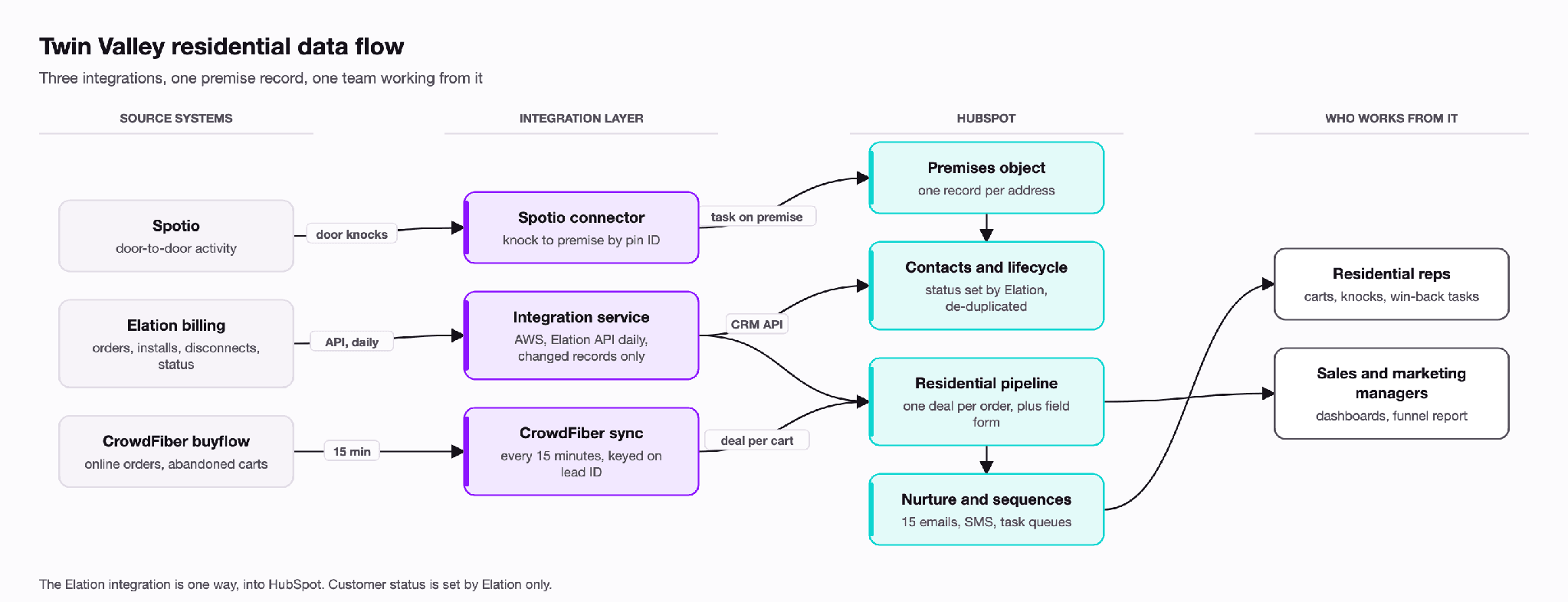
How each source reaches the one premise record in HubSpot.
View full-size diagram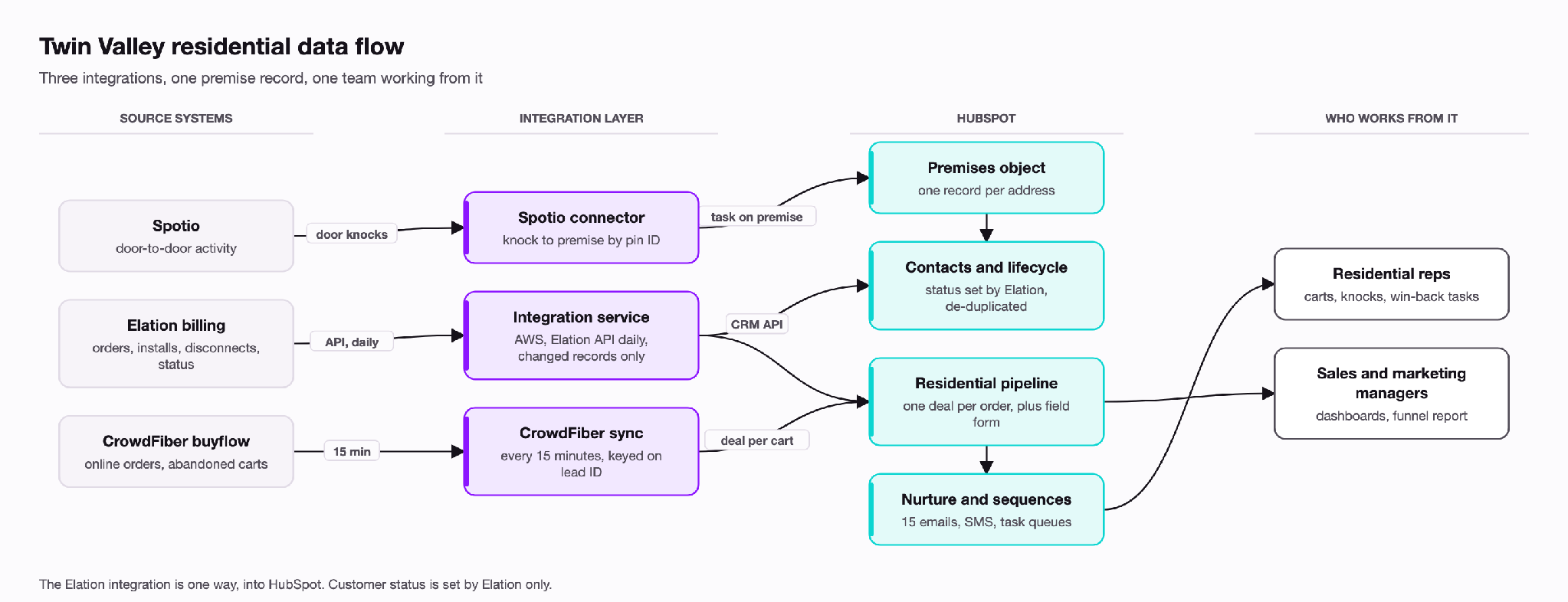
The buyflow and the field
-
A field sales order form in HubSpot that creates the deal from a conversation, with sales channel attribution on every rep-logged sale, including the individual partner behind each Advocate and Hometown Partner program sale
-
Mobile product line items on the deal and a mobile subscriber flag on the contact, showing for the first time which internet customers also take mobile
-
Sequences for abandoned carts, win-back, competitor offers and event follow-up
The Marketing Hub nurture program
-
15 nurture emails written and built behind the buyflow: a first touch sent in the local field rep's name, aged-cart follow-ups, an objection series on local support, switching, neighbors and pricing, and event follow-up
-
Every abandoned cart pushed in by CrowdFiber enrolls automatically, with SMS steps in the same workflows
-
HubSpot forms for callbacks, partner sign-ups and field orders, feeding the same premise and contact records
Reporting and documentation
-
A customer data insights dashboard and a lifecycle funnel report
-
The written Integration Logic Playbook, so the Twin Valley team can troubleshoot without us
-
A quarterly portal audit against the residential motion
Agreed next: eLation's Account Status field is being mapped onto the contact, so household status comes straight from billing and win-back reporting can run on reconnected households, and a customer drip and a win-back SMS flow are built and ready to switch on.
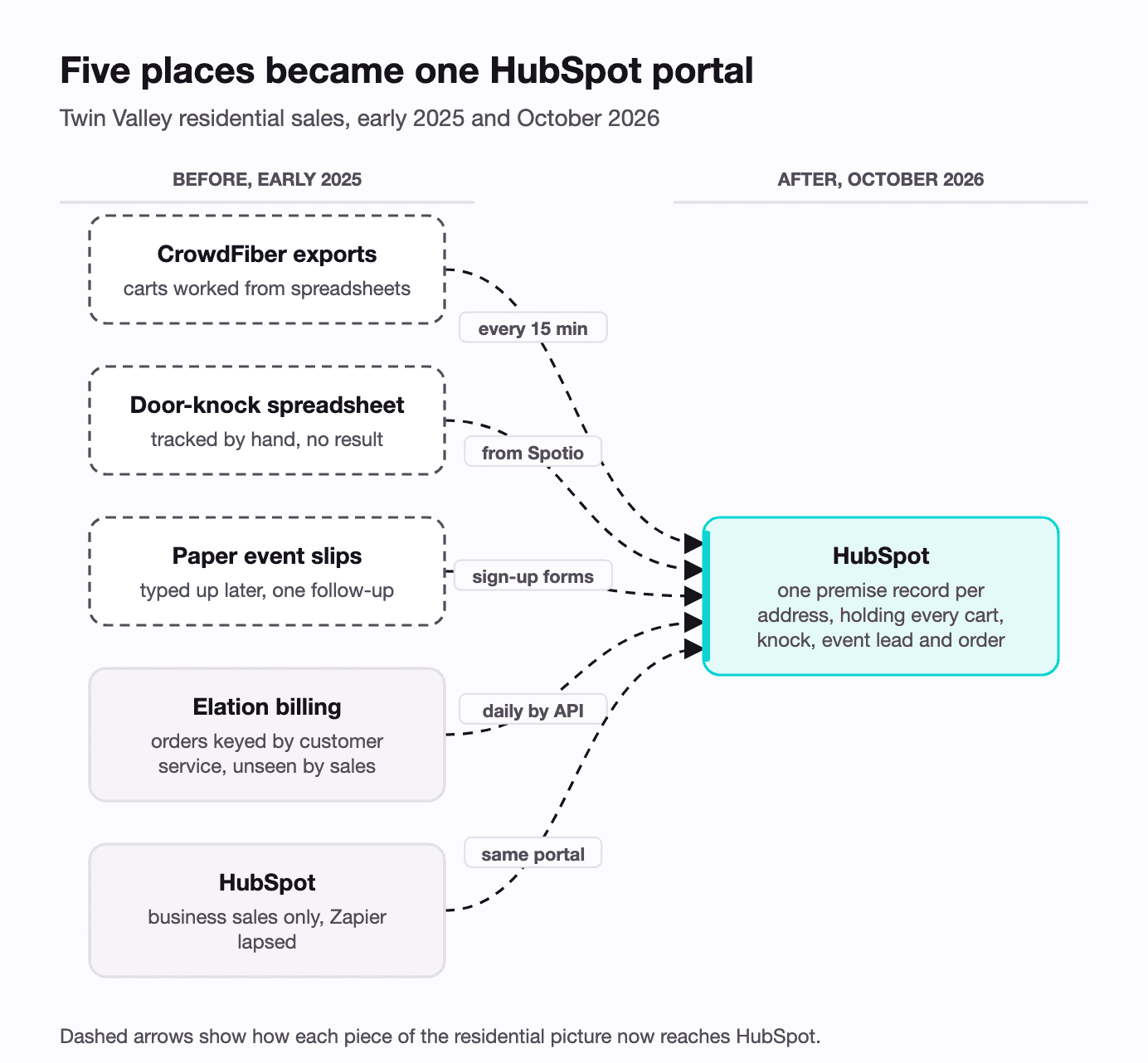
Before, five places held pieces of the residential picture. After, all of it lives in HubSpot, on one premise record per address.
View full-size diagram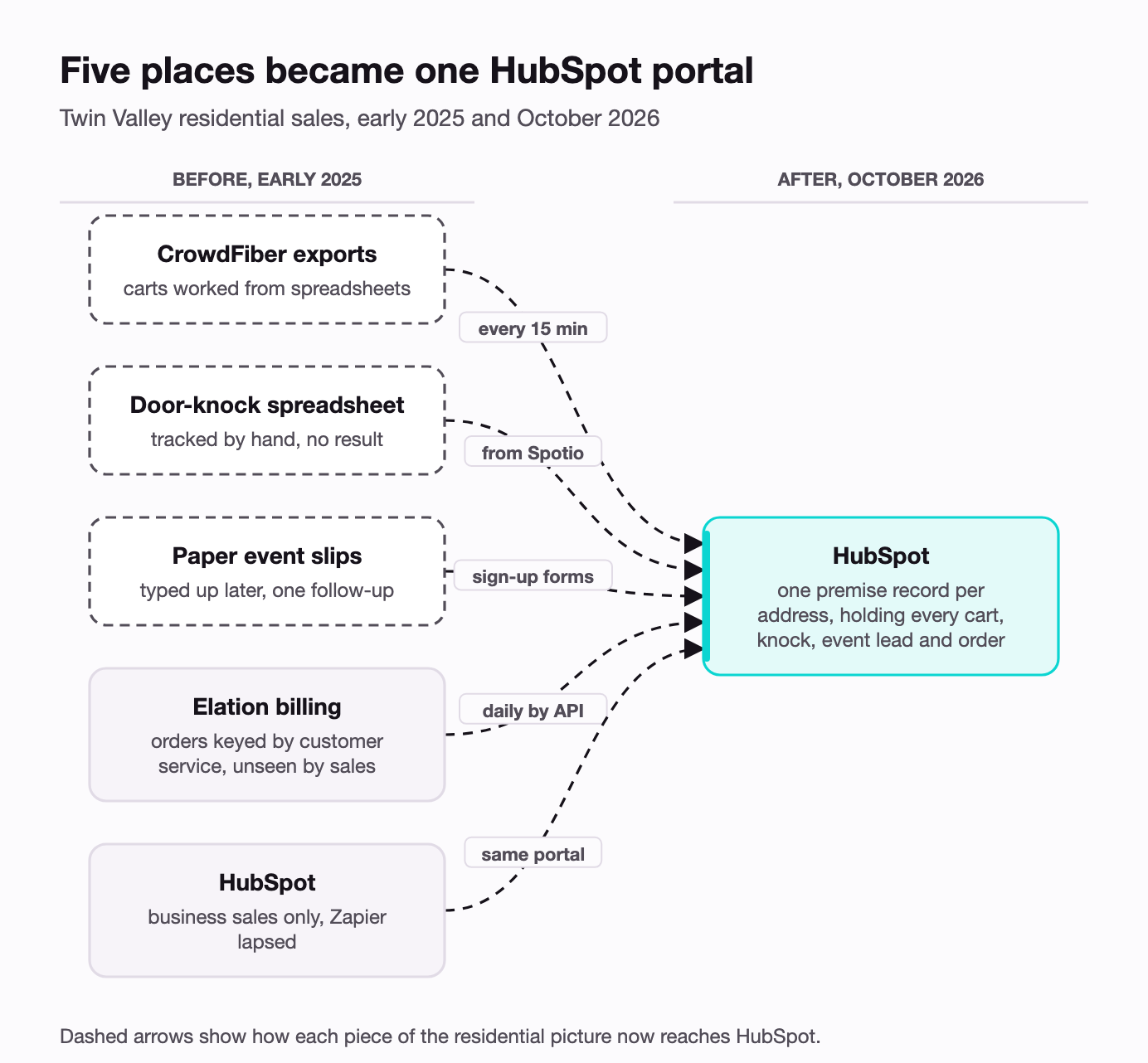
The Results
(October 2025 to October 2026)
Conversion
-
43% of abandoned carts convert into orders, measured deal by deal on every cart at least 45 days old, a number the team could never see before
-
Households the field team door-knocked ordered at 2.6 times the rate of unknocked households in the same towns within 90 days, 6.6% against 2.5%, measured across knocked households that were not already customers
-
Carts reached within a day converted at 41%, against 31% for those reached later
-
The Q3 2026 win-back program brought back 1 in 21 churned households within 60 days, measured order by order
Response speed
-
The median time from an abandoned cart to a rep's first call or text fell from 36.2 hours in Q4 2025, the quarter the sync went live, to 9.9 hours in Q3 2026
-
The share of carts reached within a day rose from 47% to 79% over the same two quarters
Visibility and data
-
55% of September 2026's orders can be traced to where they started, whether an abandoned cart, a rep's sales form or a partner, up from 12% across the first half of the year
-
Field sales logged at the point of sale, each with its sales channel, ran at more than eight times the first-half monthly rate through Q3 2026
-
97.7% of the households eLation marks as current customers carry the matching lifecycle stage in HubSpot, per the September 2026 audit, and flagged duplicate records fell 42% between July and September 2026
Team efficiency
-
Time to market was under four months, from implementation start in June 2025 to eLation orders flowing into HubSpot on 23 September
-
Twin Valley estimates each residential rep now recovers 10 to 15 hours a week that used to go to updating data across systems, logging activity by hand and compiling reports
-
Weekly reports that took one to two hours to compile are produced in under ten minutes, by Twin Valley's estimate
-
Door knocks no longer live in a spreadsheet. More than 2,600 have been logged against their address automatically since October 2025, and sequences have created more than 3,700 follow-up tasks since August 2025. More than 30 live automations and 32 sequences now run the residential motion, up from four workflows and four sequences nobody had been enrolled in
Beyond the Numbers
The bigger shift is who runs the system. The sales team builds its own dashboards, the sales manager uses Breeze, HubSpot's AI assistant, to work through workflow and reporting design, such as event leads and win-back reporting, and the reps are being retrained to build their own views rather than ask for them.
A residential rep's day now starts in HubSpot, with a task queue of cart follow-ups, win-backs and event leads instead of a spreadsheet. The engagement has grown from an audit into an implementation and an ongoing support retainer.
Testimonials
"Second Mile didn't just help us implement a new system. They helped us rethink what's possible for our residential sales operation. Their ability to understand our business, navigate complex challenges, and turn our vision into a scalable solution has been invaluable. We now have visibility and tools to make smarter decisions and support our continued growth."
Megan Harper, Director of Marketing & Sales, Twin Valley
"For years, integrating eLation with our sales and marketing systems felt like an obstacle we couldn't overcome. Second Mile changed that. We didn't have to know exactly how to build the solution, we just had to know what we wanted to accomplish. They brought the expertise to make it happen, and the result has fundamentally changed how we manage residential sales."
Shaley Johnson, Marketing Operations Manager, Twin Valley
"The biggest win for our sales team isn't just having better technology, it's having more time to sell. We've eliminated unnecessary administrative work, improved visibility across our pipeline, and made it easier for our reps to pick up right where a customer conversation left off. HubSpot gives us the tools to work smarter, respond faster, and turn more opportunities into customers."
Josh Peterson, Sales Manager, Twin Valley