





Digital systems for complex institutions.

Second Mile brings information architecture, accessible design, development, integrations, governance, and long-term support together for institutions with many audiences and distributed ownership.

Trusted by universities and membership organizations.

Selected clients across higher education, membership, and lifelong learning.

  • University of Tennessee
  • Louisiana State University
  • Rollins College
  • New York University
  • Fiber Broadband Association
  • American Ancestors (NEHGS)
  • Teaching American History

Many audiences. One maintainable platform.

Prospective students, families, current students, faculty, staff, and alumni need different paths. We connect those experiences through information architecture, accessible design, development, integrations, and publishing governance.

  1. Audience and content

    Information architecture around real questions

    Organize content around audience intent and institutional language while preserving the governance and findability the organization needs.

    • Audience and journey architecture
    • Content modeling and search
    • Migration and redirect planning
  2. Experience and platform

    Accessible design and durable development

    Build responsive systems that support varied content, assistive technology, institutional standards, and long-term maintenance.

    • Design systems and components
    • WCAG-aligned implementation
    • WordPress and HubSpot CMS development
  3. Ownership and adoption

    Publishing governance and ongoing support

    Give distributed teams the structure, training, documentation, and delivery capacity to keep the platform useful after launch.

    • Roles, permissions, and workflows
    • Editor enablement
    • Performance, support, and iteration

Relevant proof

A useful platform keeps the work moving.

They keep projects moving on schedule, turn things around quickly, and provide valuable insights rooted in data and research.
Brittany C.The University of Tennessee
Proof storyUT AdmissionsWebsite architecture and redesign for prospective students.Read the work

Different audiences. Long-term institutional work.

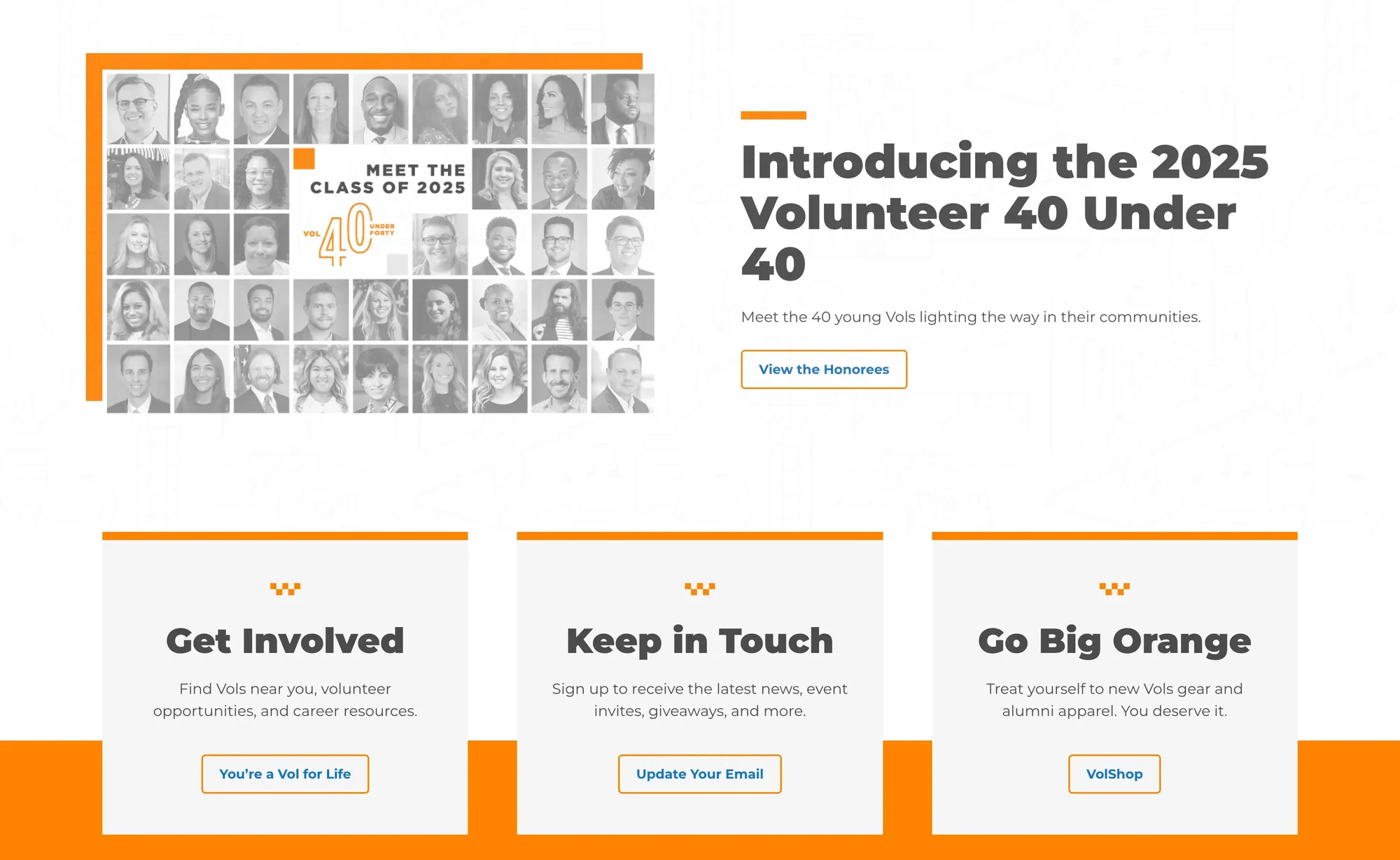
Our University of Tennessee work spans admissions, online learning, dining, alumni, student services, conferences, and professional education. Explore full case studies and shorter project snapshots.

University of Tennessee Project Library

How the work starts

Plan for the institution. Build for its people.

Content, accessibility, ownership, and technology decisions need to work across departments. We agree those responsibilities before building, then prepare the people who will keep the site useful.
  1. Map

    Understand audiences and ownership

    Review audience journeys, existing content, accessibility requirements, and the people who publish. Identify what must survive a redesign or migration.
  2. Build

    Test the real publishing work

    Develop the design system, templates, content, and integrations. Review representative pages and audience journeys, including redirects and accessibility.
  3. Adopt

    Prepare distributed publishers

    Train editors, document roles and workflows, and agree how changes will be reviewed. Plan support and iteration around the institution's ongoing needs.

Choose the next useful step

Find your next move.

We will help identify the people, content, governance, technology, and smallest useful phase required to move the institution forward.

Talk through the problem

Connect with our team

Talk through your challenges and see if Second Mile is the right partner to help.

Talk through the institution

Find the right service

Explore our services

See the evidence

Explore our work

Before an institutional build.

Which institutional audiences can the website support?

Prospective students and families: Find the right program, understand the institution, compare options, and complete the next step without learning the org chart. Current students: Reach timely services, policies, resources, and transactions from the devices and contexts they already use. Faculty, staff, and publishers: Create accurate, accessible content within a governance model that works across distributed teams and ownership. Alumni and continuing learners: Maintain a useful relationship through programs, events, services, giving, and professional development.

How do you work with distributed publishers?

Start by identifying who owns each content type and which decisions require central approval. Roles, templates, documentation, and editor training should support that model rather than make every update a developer task.

Can a redesign preserve an existing content and URL structure?

The migration plan identifies which content and URLs should remain, which need to change, and where redirects are required. Decisions follow audience needs and the current site's dependencies rather than assuming every page must be rebuilt.

Does accessible implementation replace institutional review?

No. Accessibility is part of the design and implementation work, while the institution's requirements and review responsibilities remain explicit. Content authors and platform owners need a process for maintaining accessibility as the site changes.