- Format
- Insight
- Topics
- HubSpot for ISPs
Why Does HubSpot Lose the First Touch on ISP Orders, and How Do You Fix It?
- Written by
- Hannah Collins
- Published
HubSpot gives a deal its original source from the contact attached to it, and in an ISP buy flow the contact is created last, after the address search, the plan, and the add-ons. By then the campaign that brought the visitor in is often gone. The fix is to create the deal at the address search and record the campaign on that deal right away.
If you lead marketing at a fiber or broadband provider, you can probably say how many orders came in last month. The harder question is which campaigns started them, and it's the one leadership asks first, because it decides where next quarter's budget goes. Most providers we talk to are working from a source report they don't fully trust, and the reason is structural rather than anything the team did wrong.
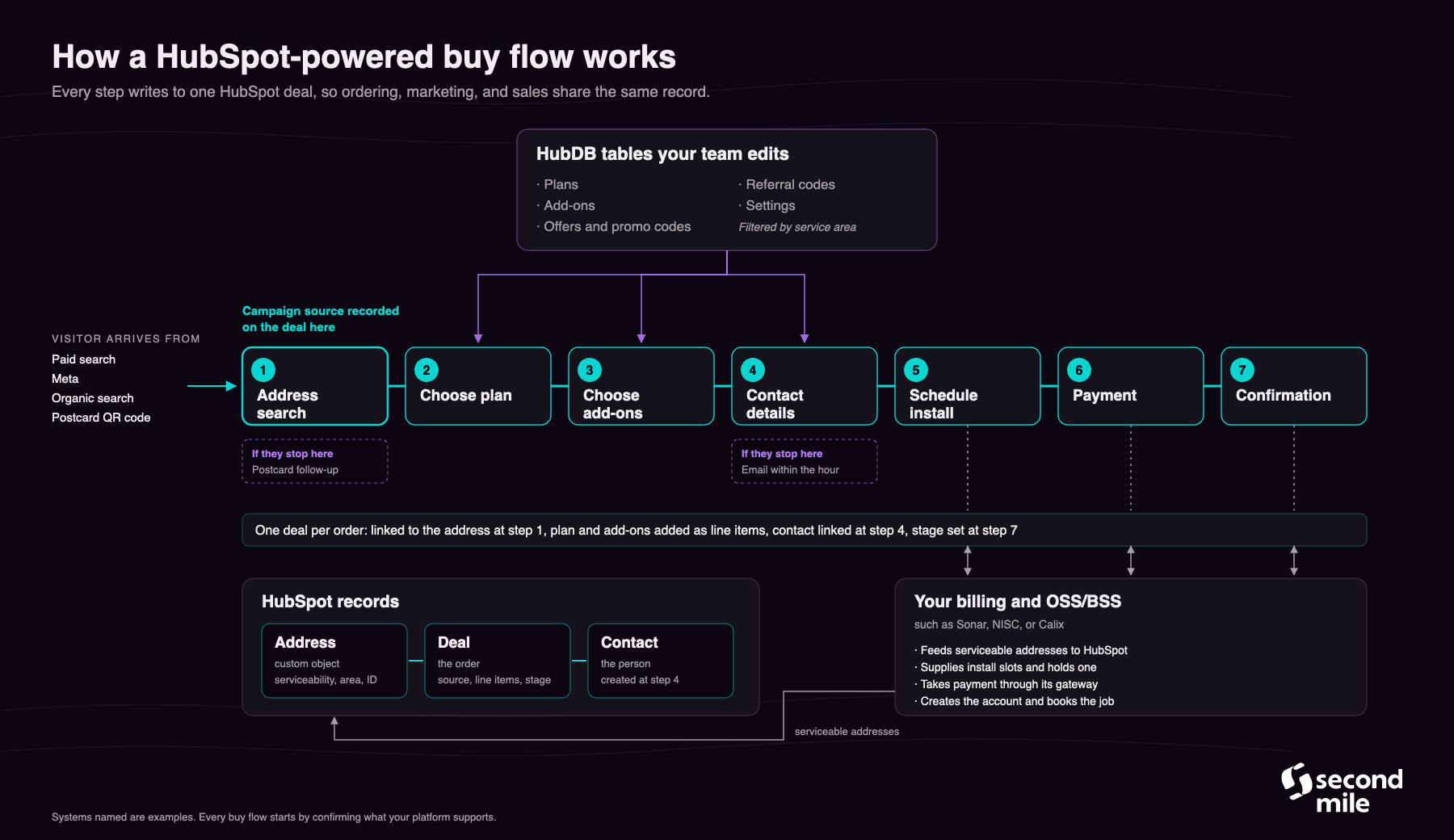
Step 1, address search: campaign recorded here, on the deal. Step 4, contact details: where HubSpot records it by default, from the contact.
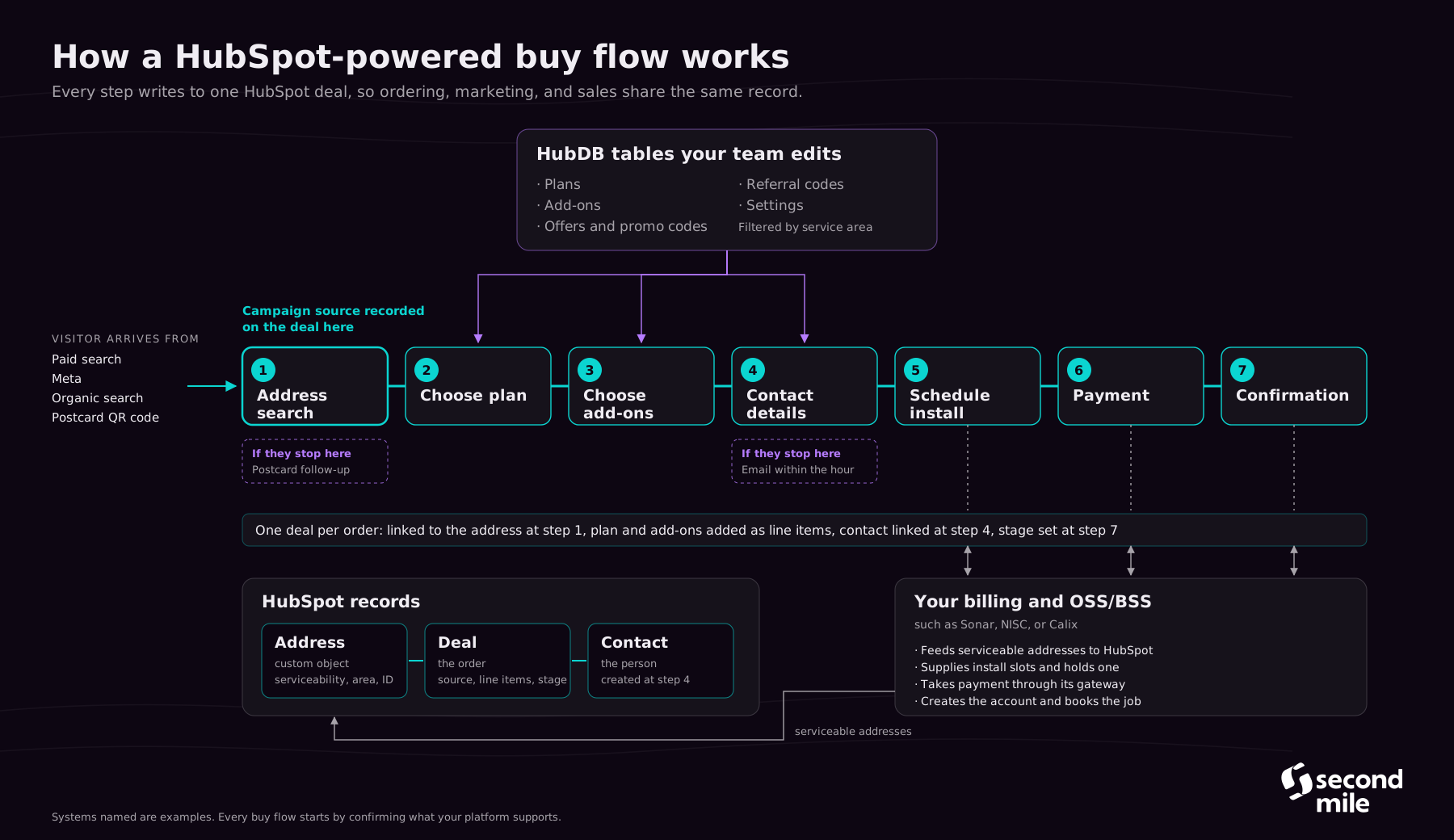
View the full-size buy-flow diagram
Why does attribution matter so much to fiber providers?
Take rate is the number a provider's leadership watches: the share of homes passed that become paying subscribers. Every marketing dollar is supposed to move it, and every channel competes for the same budget. Paid search, Meta, postcards, door hangers, events, and door-to-door sales all claim credit, and without reliable attribution the loudest channel tends to win the argument.
The question also gets more specific as a provider grows. A board may want orders by campaign by market. A provider building with grant money may have to show spending against a specific build project. A marketing leader wants to know which neighborhoods respond to a postcard and which respond to a Facebook ad. All of that depends on knowing what started each order.
How does HubSpot decide where a deal came from?
HubSpot tracks a visitor's source on the contact record. The original source is set when the contact is first created, and HubSpot also keeps a latest source that updates as the person comes back through new channels. When a deal is created and associated with a contact, the deal takes its source from that contact.
That design works well for the businesses HubSpot was first built around. At a software company, someone fills in a form, a contact is created on the spot, and the deal follows days or weeks later. The contact comes first, so the source is already there when the deal needs it.
Why does an ISP buy flow break that?
A provider's buy flow runs in the other order. A visitor arrives from an ad or a search, types in an address, picks a plan, adds a Wi-Fi extender or a phone line, and only then gives a name and an email. Asking for contact details late is usually a good decision, since people are more willing to share them once they've seen a price.
The cost shows up in the reporting. By the time a contact exists, several things can have gone wrong with the source:
- The campaign parameters are gone. UTM parameters arrive on the first page's URL. If nothing captures them there, they're lost by step four.
- The visitor has changed domains. When a buy flow hands off to a checkout on another domain, the tracking cookie often doesn't follow, and HubSpot sees a new visitor with no history.
- The contact already exists. When a current subscriber upgrades, the new deal inherits the original source from the day they first signed up, which might be a mailer from years ago, and the campaign that brought them back gets no credit.
Orders finished by a person add one more gap. When an inside sales rep or a door-to-door team completes an order that started online, HubSpot sees the rep's session, and the report fills up with direct traffic.
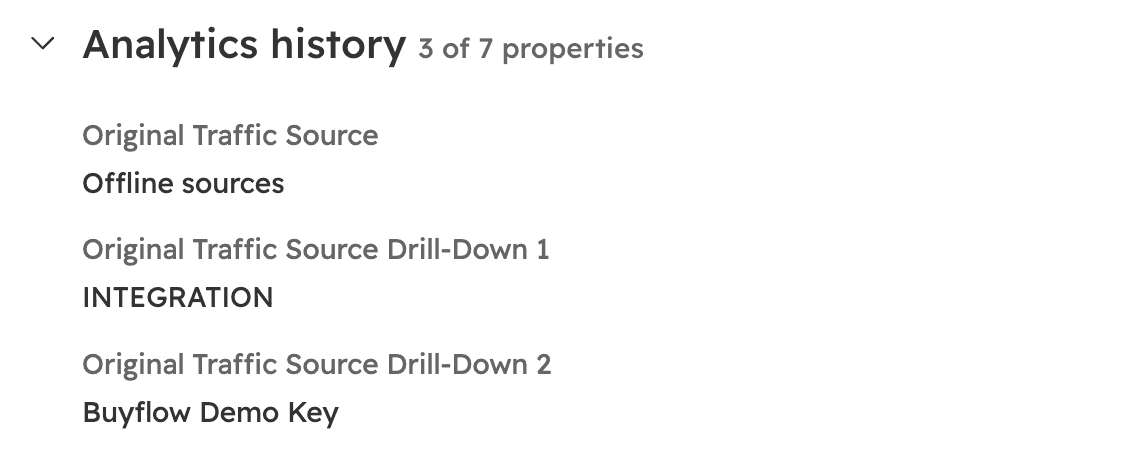
HubSpot demo record: Original Traffic Source is Offline sources, with INTEGRATION and Buyflow Demo Key in its drill-down fields. Demo data.
How do you record the first touch on the deal instead?
In the HubSpot-powered buy flows we build, the order of operations is changed to match how a provider sells.
- The deal is created at the address search. As soon as an address checks out as serviceable, a deal is created and associated with the address record (some providers call it the passing, the premise, or the rooftop). No contact is needed yet.
- The campaign is read from the URL at that moment. The buy flow pulls the UTM parameters from the landing URL and writes them to custom properties on the deal: source, medium, campaign, and content, kept as both first and latest values.
- The visitor stays on your domain. Running the buy flow on HubSpot's CMS, on your own domain or subdomain, keeps the tracking cookie intact from the ad to the confirmation page.
- Every step adds to the same deal. The plan and add-ons land as line items, the contact is associated when it's created, and the install booking moves the deal to its own stage, so the deal carries the full story of the order.
- Offline channels carry their own tags. QR codes on postcards and door hangers point to URLs with UTM parameters, so print gets credit the same way an ad does.
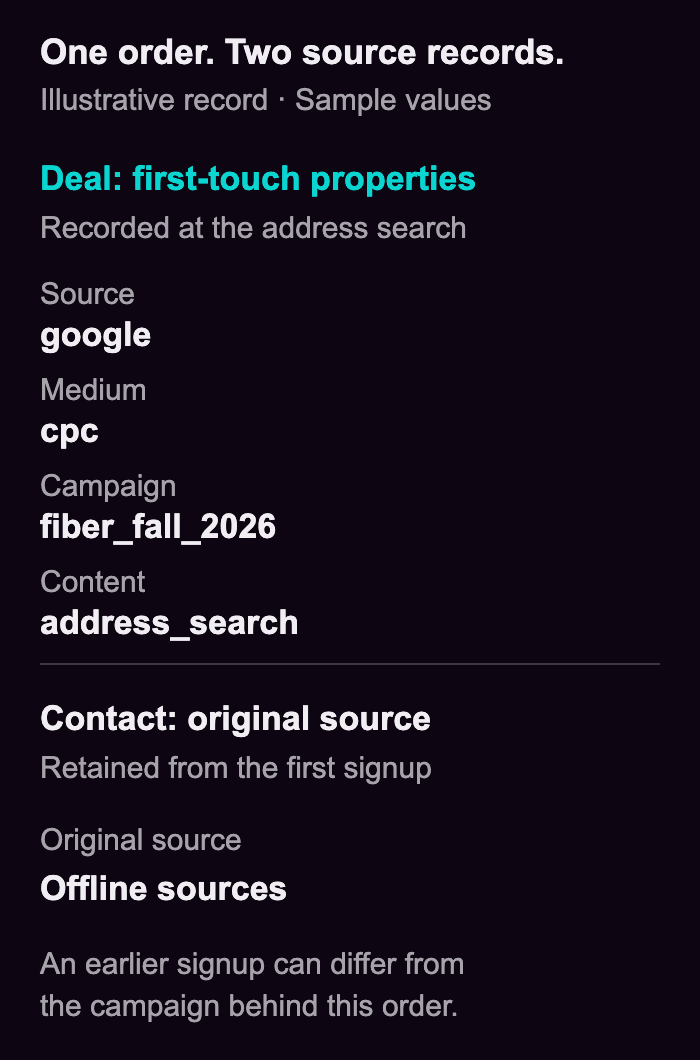
Illustrative comparison with sample values. First-touch deal properties record the campaign for this order; the contact retains its original source.
The result is a first-touch source for each order, tied to the address it came from and the market that address sits in, which is the view a provider's reporting needs.
What should you expect from attribution, realistically?
No setup catches every visit. People block cookies, switch from a phone to a laptop, or call in after seeing a yard sign. Anyone who promises complete attribution is promising something the browser won't allow.
Three habits make the numbers more useful. Decide which question each report answers: deal-level first touch answers "what started this order," HubSpot's native multi-touch reporting answers "what did this person see along the way," and the two will disagree, which is fine as long as everyone knows which one they're reading. Track the share of orders with a recorded source and watch it climb, instead of arguing over individual deals. And pull the report the same way on the same day each month, so leadership is comparing like with like.
What does this look like at a provider?
ALLO Fiber's own developers built its buy flow, and Second Mile architected the HubSpot foundation it runs on, with custom objects for addresses and product bundles, a live serviceability lookup, and every order landing in the CRM in near real time. Before the move from Salesforce Marketing Cloud, 96 of every 100 contacts arrived with no digital trail. Since go-live, 28 of every 100 new contacts carry full web attribution, a sevenfold increase. Read the ALLO Fiber case study.
For Core Fiber, we built the buy flow inside HubSpot with the campaign recorded at the address search from the first day, so every order arrives with its source and its market attached.
Where should you start in your own portal?
Four checks take about an hour and tell you how big the gap is:
- Run a report of closed deals by original source. If direct traffic or offline sources dominate, the source is being recorded too late or lost on the way.
- Find where deals are created. If a deal only appears when a contact submits a form, the first steps of the buy flow leave no record.
- Follow an ad click to the confirmation page. If the domain changes anywhere along the way, the tracking cookie is likely breaking there.
- Check your print pieces. If postcard and door hanger QR codes point to a bare URL, print is being counted as direct traffic.
If those checks turn up gaps, our team maps where the source is lost and what it would take to fix it in your setup, including whether your current buy flow can be adjusted or needs to move into HubSpot. Our work with internet service providers starts with the address for exactly this reason.
Book a meeting with our team →
Frequently asked questions
Can HubSpot do multi-touch attribution for an ISP?
Yes, for contacts. HubSpot's native attribution reports track the channels a person touched along the way. What they can't do on their own is record the campaign on a deal that exists before its contact, which is how most ISP buy flows work. Deal-level first-touch properties fill that gap, and the two reports work side by side.
Do we need to rebuild our buy flow to fix attribution?
It depends on where your buy flow runs. If it already runs on your domain and can create a deal at the address search, the fix is usually a set of deal properties and a script that captures UTM parameters. If it hands visitors to a checkout on another domain, some of the source will keep getting lost until that handoff changes. An audit tells you which case you're in.
How accurate can ISP attribution get?
Never complete. Cookie blocking, device switching, and phone orders all leave some orders without a recorded source. The practical goal is a high, rising share of orders with a recorded first touch, measured the same way every month, so budget decisions rest on a trend you trust.
Working through a related operating problem? Talk through the architecture.