.svg)

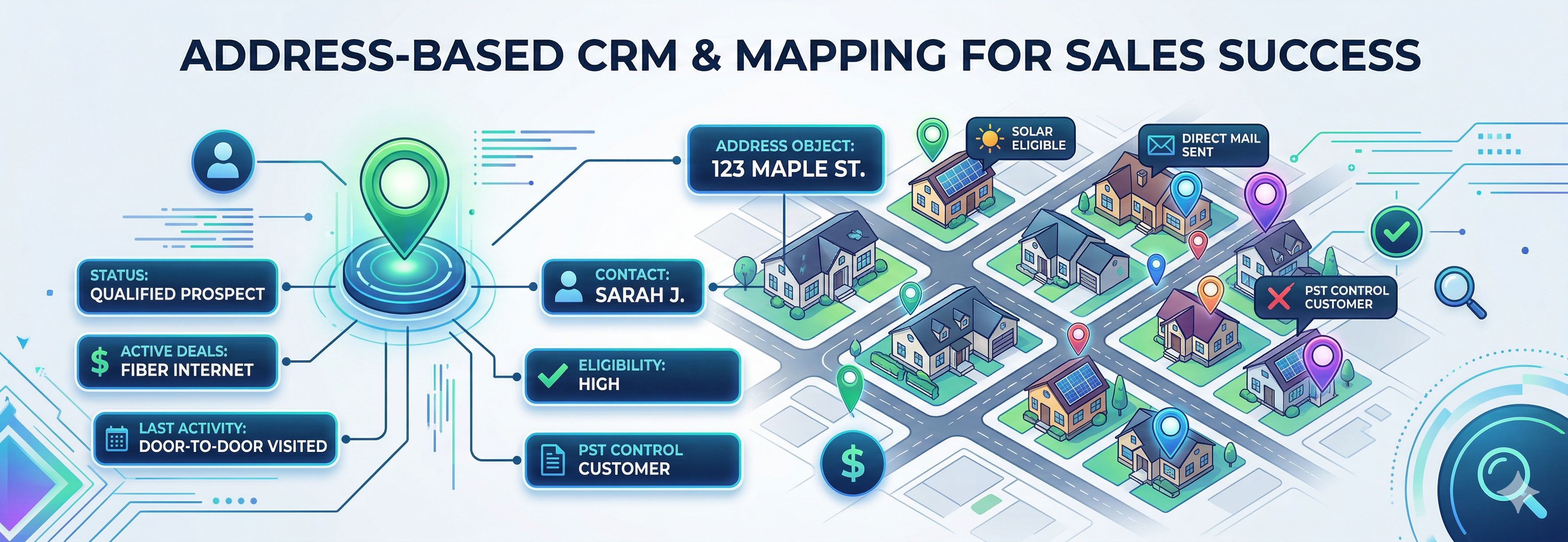
An address-based CRM is a customer relationship management system that treats physical addresses as a first class data object, alongside contacts and companies. Instead of tying all activity to individual people, an address-based CRM allows teams to track, segment, automate, and report on households, buildings, and service locations. This is essential for industries that market and sell by location, including ISPs, solar providers, pest control companies, and home services.
Simply put, an address-based CRM has an object specifically for addresses, in the same way you would have one for companies or contacts. This meets the obvious need for companies that market and sell to addresses in addition to contacts or companies.
Why contact-based CRMs fail for ISPs and location-based businesses
Contact-based CRMs have the core capabilities for marketing and sales teams but lack the extra layer required by those teams that need to target and report on addresses or neighborhoods.
Some basic example requirements:
- Contacts move, addresses do not
- Multiple buyers and decision makers exist at one address
- Serviceability is address based, not contact based
- Reporting by neighborhood, MDU, or territory is impossible without workarounds
When the address based reporting is required, teams often end up relying on spreadsheets or third party tools to solve for that missing layer.
This end up creating slow manual processes, outdated and silo’d data, and delayed campaigns. It also leaves marketing teams stuck in data cleanup mode rather than working on strategy.
Address object data models: visuals
In an address-based CRM, the address object becomes the central source of truth. Contacts, companies, subscriptions, serviceability, and campaigns all relate back to a single address record.
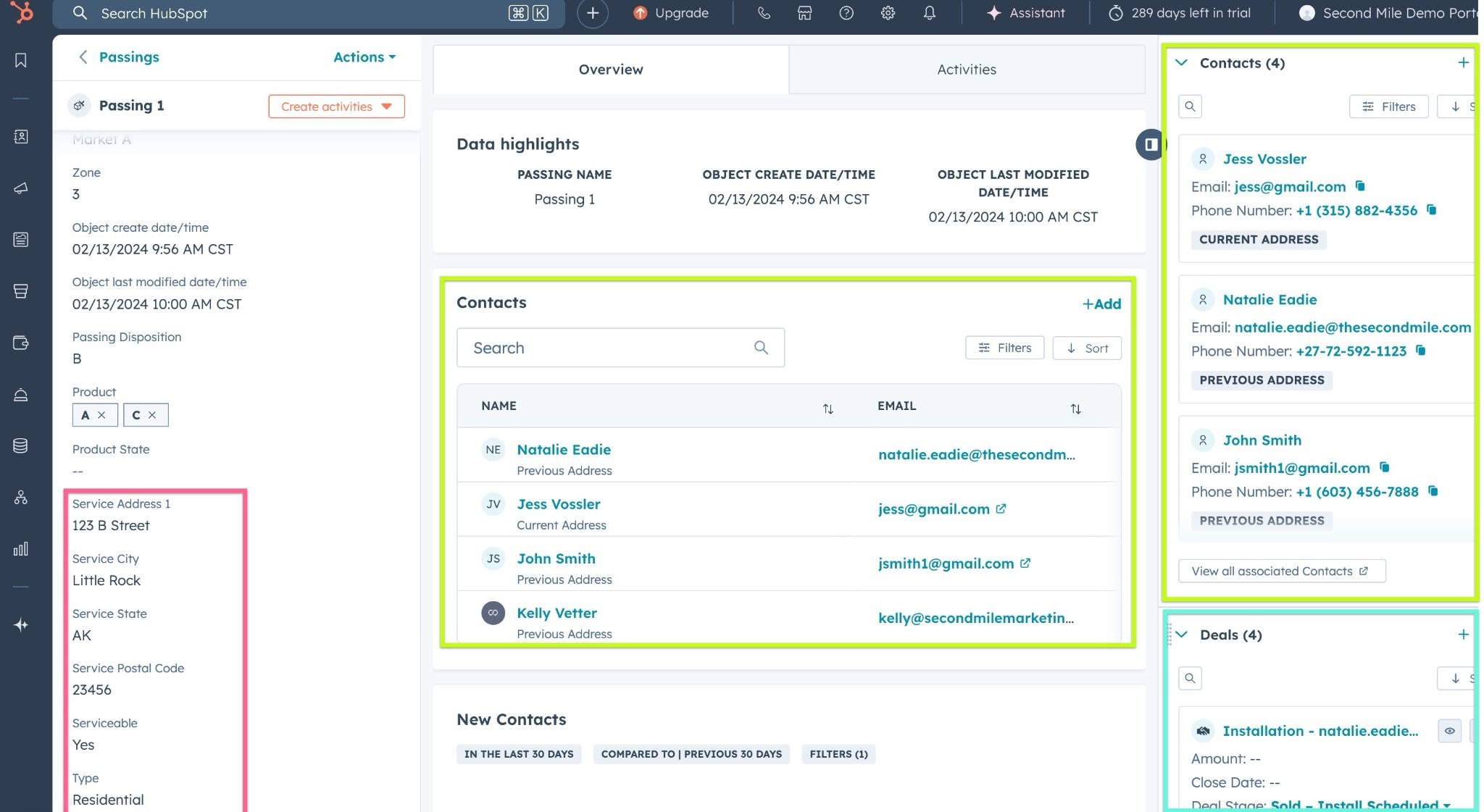
The pink outline shows address details, green represents associated contacts, and blue shows associated deals.
Automations unlocked by address-based CRM
When the address custom object is in place, the options for campaigns can be greatly expanded on:
- Promotions can be deployed in your ecommerce system to target specific neighborhoods or addresses
- Direct mail and door-to-door campaigns can be automated to go out based on specific trigger events
- Time sensitive campaigns like retargeting rental units based on average turnover time can now be automated
- Reporting can be done on an address basis
- Integrating ecommerce allows for retargeting prospects who abandoned a cart or visited a site page with mailers and door-to-door reps
How to build an address-based CRM in HubSpot
When selecting a CRM, HubSpot works especially well for address-based CRM builds because custom objects, automation, and reporting are available in one platform without heavy engineering or ongoing admin overhead.
With HubSpot as the system of action, companies can:
- Automatically route and qualify leads
- Assign sales reps based on serviceability and territory
- Trigger campaigns from subscriber or network events
- Run onboarding, education, upsell, and retention workflows
- Align marketing, sales, and service around a single customer record
Real-world results: metrics + case studies
After implementing an address-based CRM in HubSpot for Dobson Fiber, the team saw the following results within six months:
- 82% increase in leads
- 499% lead conversion
- 37.5% decrease in disparate software systems and technical debt
You can read Dobson Fiber’s case study for yourself here: www.thesecondmile.com/case-studies/dobson-fiber
Who should use an address-based CRM
ISPs and fiber providers
- ISPs sell, market, and service at the address level, not the contact level. An address-based CRM allows fiber providers to track serviceability, network status, and subscriber lifecycle by location, making it easier to coordinate pre build demand, manage MDUs, assign territories, and route leads to the right sales rep. This becomes especially critical as multiple contacts, decision makers, and subscribers exist at a single address over time.
Solar companies
- Solar companies market to households and properties, not just individual buyers. An address-based CRM makes it possible to track home eligibility, system history, previous outreach, and ownership changes at the property level. This allows marketing and sales teams to avoid duplicate outreach, automate follow ups when homeowners change, and report on performance by neighborhood or territory.
Pest control
- Pest control businesses rely on recurring service tied to physical locations. An address-based CRM helps teams manage ongoing treatments, seasonal campaigns, and upsell opportunities by address rather than by individual contact. This makes it easier to coordinate routing, track service history, and market to new occupants when residents move.
Home services
- Home services companies often serve the same address multiple times across different service lines and ownership changes. An address-based CRM creates a single source of truth for service history, warranties, and past work at each location. This allows teams to run smarter reactivation, maintenance, and cross sell campaigns based on the property, not just the person who last booked a job.
Book an address-based CRM assessment
You can speak to one of our experts for an address-based CRM assessment here.
.jpg)
.jpg)
.jpg)