- Format
- Insight
- Topics
- HubSpot · Data architecture · Integrations · ISPs
Why Address-Based Sales and Marketing Teams Need an Address-Based CRM
Address-based sales teams in telecom, home services, and solar need CRMs built around locations, not contacts. Learn how address-based CRMs improve targeting, automation, and close rates.
- Written by
- Jacob Kedra
- Published
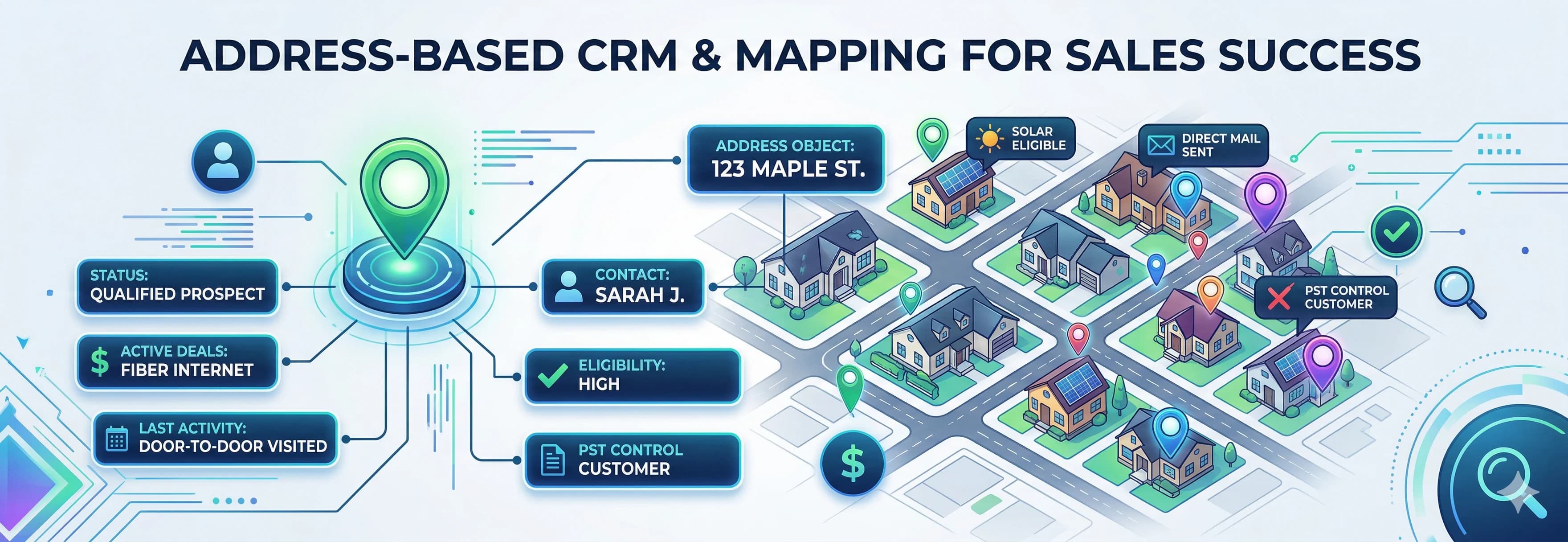
Address-based sales teams face a unique challenge. They sell to locations, not just people.
Industries like telecom, home services, solar, and pest control all rely on targeting specific addresses. Yet many of these teams still operate inside contact-based CRMs. That mismatch creates inefficiencies across marketing, sales, and operations.
If your business sells to homes or properties, an address-based CRM is not optional. It is foundational.
The Problem With Contact-Based CRMs in Address-Based Industries
Most CRMs are designed around people, not properties. When teams rely only on contacts, several issues appear:
- Marketing and sales campaigns are built without a true location anchor
- Multiple contacts at one address are treated as separate opportunities
- Campaign targeting becomes manual and error-prone
- Sales reps spend time managing spreadsheets instead of selling
This approach limits scale. It also slows down the lead-to-close process because teams are constantly stitching data together instead of using automated workflows.
Why Address-Based Campaigns Matter
In address-based fields, the address should be the baseline object for all campaigns.
Whether you are running:
- Door-to-door sales
- Direct mail campaigns
- Neighborhood-based promotions
- Standard email outreach tied to serviceability
You need the ability to enroll address records into workflows and use location data to organize campaign targeting. In HubSpot, marketing emails go to associated contacts who are eligible to receive them, with the address record providing the location context.
Without that capability, your team’s bandwidth is capped by manual work.
The Solution: Build an Address-Based CRM Using a Custom Object
The most effective solution is creating a custom address object that acts as the residence or service location.
Once this object is in place, you can:
- Import addresses from Google Earth or a native GIS system
- Treat each address as a single source of truth
- Associate contacts, deals, and service data to the address
- Trigger workflows and campaigns based on location data
This structure mirrors how address-based businesses actually sell.
What Becomes Possible With an Address-Based CRM
Once addresses are the core object, campaign creativity and precision increase dramatically.
Examples include:
- Targeting entire neighborhoods with specific promotions
- Retargeting rental properties after average move-out timelines
- Coordinating door-to-door and direct mail campaigns by geography
- Tracking penetration, eligibility, and service status at the address level
Instead of asking “Who should we contact?”, teams can ask “Which addresses should we target next?”
Why HubSpot Works Well for Address-Based Sales Teams
HubSpot is Second Mile’s preferred CRM for address-based campaigns.
Building this in HubSpot requires an eligible Enterprise subscription for custom objects. Workflow actions and integrations depend on your subscription and connected tools.
It offers:
- Flexible custom object configuration
- Strong workflow automation tied to objects
- Clean integrations with direct mail, GIS tools, and door-to-door platforms
- Scalability without heavy technical overhead
When set up correctly, HubSpot becomes a true address-based CRM rather than just a contact database.
Frequently Asked Questions About Address-Based CRMs
What is an address-based CRM?
An address-based CRM is a system where physical locations are the primary object, with contacts, deals, and activities associated to each address.
Who needs an address-based CRM?
Businesses that sell or market to physical locations, including fiber internet providers, home services companies, solar installers, and pest control companies.
Can HubSpot be used as an address-based CRM?
Yes. With an eligible Enterprise subscription, custom objects, and proper data modeling, HubSpot can fully support address-based sales and marketing workflows.
Need Help Building an Address-Based CRM?
If you are looking for guidance on designing or implementing an address-based CRM, the Second Mile team is happy to help.
Working through a related operating problem? Talk through the architecture.